The project
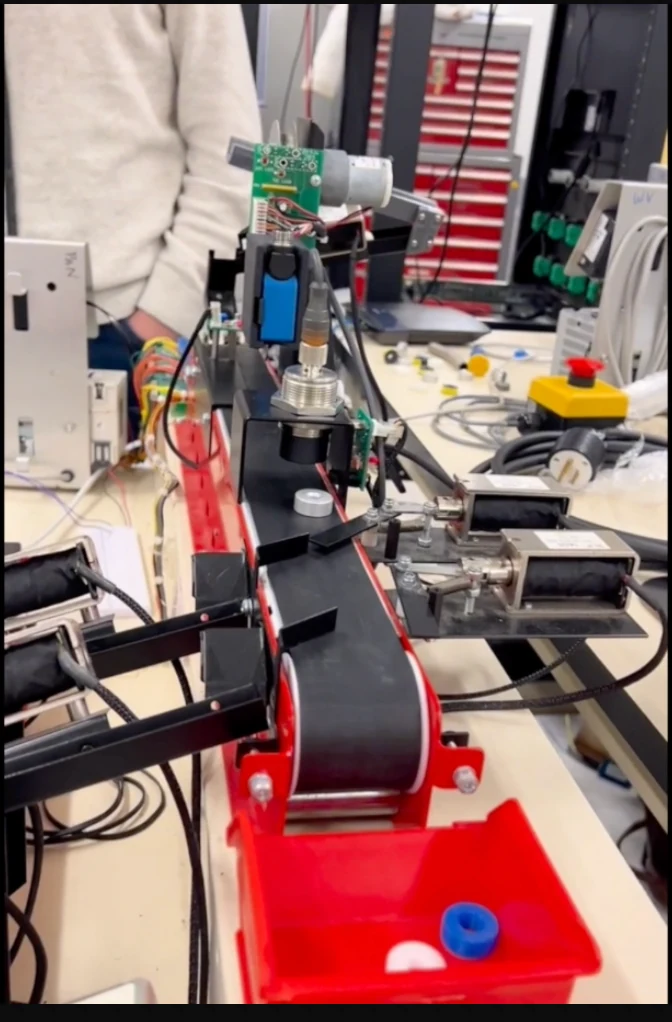
This project focused on building a complete automated production and palletizing system. Metal and plastic washers are dispensed onto a conveyor, inspected for height, identified by material, and routed to the correct location. Once the required parts are available, the system releases a peg, assembles the final product, and hands the completed part to an Epson T3 SCARA robot for palletizing.
PLC & conveyor programming
I programmed the production line using CLICK PLC ladder logic and divided the process into phases so each action occurs in the correct sequence. The PLC controls conveyor motors, washer and peg dispensers, the height-inspection system, sensors, solenoids, and the exit guide.
An optical sensor detects and positions each washer under the height probe. If the part passes inspection, an inductive sensor identifies whether the washer is metal or plastic. The PLC then activates the matching solenoid chute.
Part tracking & assembly
PLC counters track the available metal and plastic washers. When enough parts are present, a peg is released onto the lower conveyor and one metal washer plus one plastic washer are added to build the final product. Sensors and timers synchronize the cycle so a new product does not begin before the previous one is complete.
HMI & robot integration
The HMI provides operator control for the automated process. The PLC communicates with the Epson T3 SCARA through discrete I/O. Start, Stop, Pause, Continue, and Reset commands can be coordinated from the PLC side so the conveyor system and robot operate as one workcell.
SCARA palletizing
The robot was programmed in SPEL+. Physical pick locations and pallet reference points were taught to the robot, which then follows the sequence:
- Pick the finished product
- Activate the gripper
- Move to the pallet
- Release the product
- Return for the next part
Epson’s built-in pallet function was used to create a 2 × 2 pattern. Three reference positions were taught and the software calculated the remaining placement position.
What I took away
The project strengthened my understanding of PLCs, sensors, conveyors, HMIs, and industrial robots as parts of a single automation architecture. It also reinforced the importance of breaking a complex process into smaller control phases, using sensors for real-time decisions, tracking parts with counters, and coordinating robot motion with production equipment.